


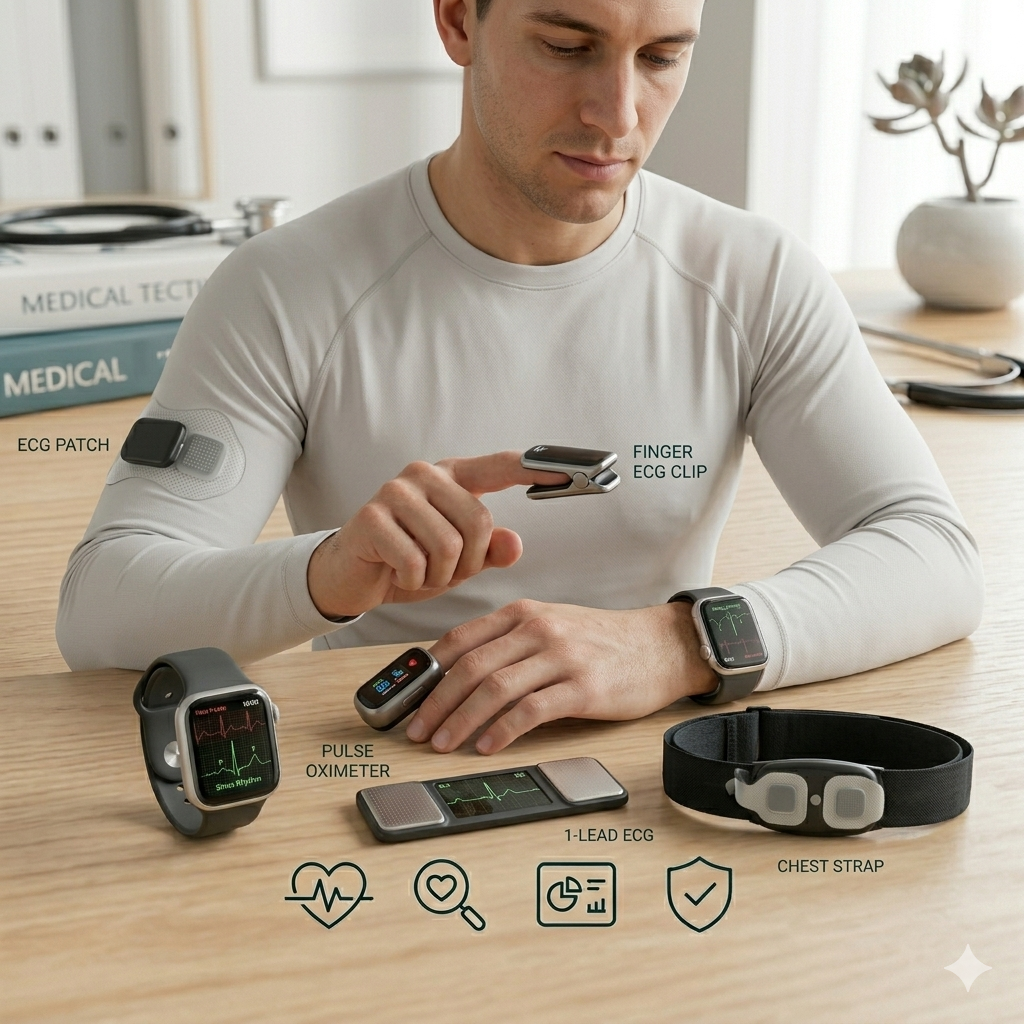
Most people don’t think about their heart until something feels wrong. A strange flutter during dinner. A pounding chest at rest. That weird, skipped-beat sensation that vanishes the moment you try to describe it to your doctor. These moments are unsettling — and what makes them even more frustrating is that a 10-second ECG at a clinic rarely catches anything that happens occasionally or unpredictably.
That’s exactly why the heart rate monitor with ECG has become one of the most searched and most purchased health devices of 2026. It’s not just for cardiac patients anymore. It’s for anyone who wants real answers, in real time, from the place where heart symptoms actually happen — everyday life.
This guide covers everything you need to know about choosing the right heart rate monitor with ECG: how they work, which types exist, what separates a trustworthy device from a gimmick, and who genuinely benefits from using one. No fluff, no filler — just the information that actually helps you make a smart decision.
What Is a Heart Rate Monitor with ECG — and Why Does It Matter?
A heart rate monitor with ECG is a device that captures the electrical activity of your heart, not just your pulse count. When your heart beats, it produces a tiny electrical signal that travels through the cardiac muscle in a very specific pattern. An electrocardiogram — ECG or EKG, both mean the same thing — records that signal as a waveform and displays it as a rhythm strip that trained algorithms (or cardiologists) can interpret.
This is fundamentally different from what a standard heart rate monitor does. A basic monitor counts how many times your heart beats per minute. A heart rate monitor with ECG shows the actual shape and timing of each beat — which is the only way to detect rhythm abnormalities like atrial fibrillation, premature beats, or conduction issues that a simple pulse count would completely miss.
Why does the ECG component matter so much? Because the most dangerous heart rhythm disorders often occur at normal heart rates. Atrial fibrillation, for example, can present with a completely average pulse of 70 beats per minute while the electrical pattern behind those beats is chaotic and stroke-inducing. No standard heart rate monitor in the world catches that. A heart rate monitor with ECG can.
Who Actually Needs a Heart Rate Monitor with ECG?
The honest answer to this question is broader than most people expect. Yes, the obvious candidates are people with diagnosed arrhythmias, those recovering from cardiac procedures, or patients whose cardiologists have specifically recommended remote monitoring. But the pool goes well beyond that.
People experiencing unexplained symptoms. Palpitations, dizziness, sudden shortness of breath, or an inexplicable sense that something is off — these symptoms are notoriously difficult to capture in a clinical setting because they come and go. A heart rate monitor with ECG in your pocket or on your wrist means you can record exactly what your heart is doing the moment a symptom strikes.
Anyone over 40 with no prior diagnosis but a family history of heart disease. Establishing a baseline with a heart rate monitor with ECG early on makes it far easier to detect changes over time. Proactive monitoring is genuinely more valuable than reactive monitoring.
Athletes who train at high intensity. Chest strap heart rate monitors with ECG sensors capture the electrical signals of the heart directly, providing more precise readings than optical wrist sensors — especially during high-intensity efforts where motion artifact can throw off optical readings significantly.
People managing stress and anxiety with cardiac symptoms. Having a heart rate monitor with ECG that can show you a clean, normal rhythm strip during a moment of anxiety can be genuinely calming — and if something is abnormal, it gives you concrete data to bring to a doctor rather than a vague description of how you felt.
The Five Types of Heart Rate Monitor with ECG You Need to Know
The category of “heart rate monitor with ECG” is broader than a single product type. Understanding the different form factors helps you choose what actually fits your life.
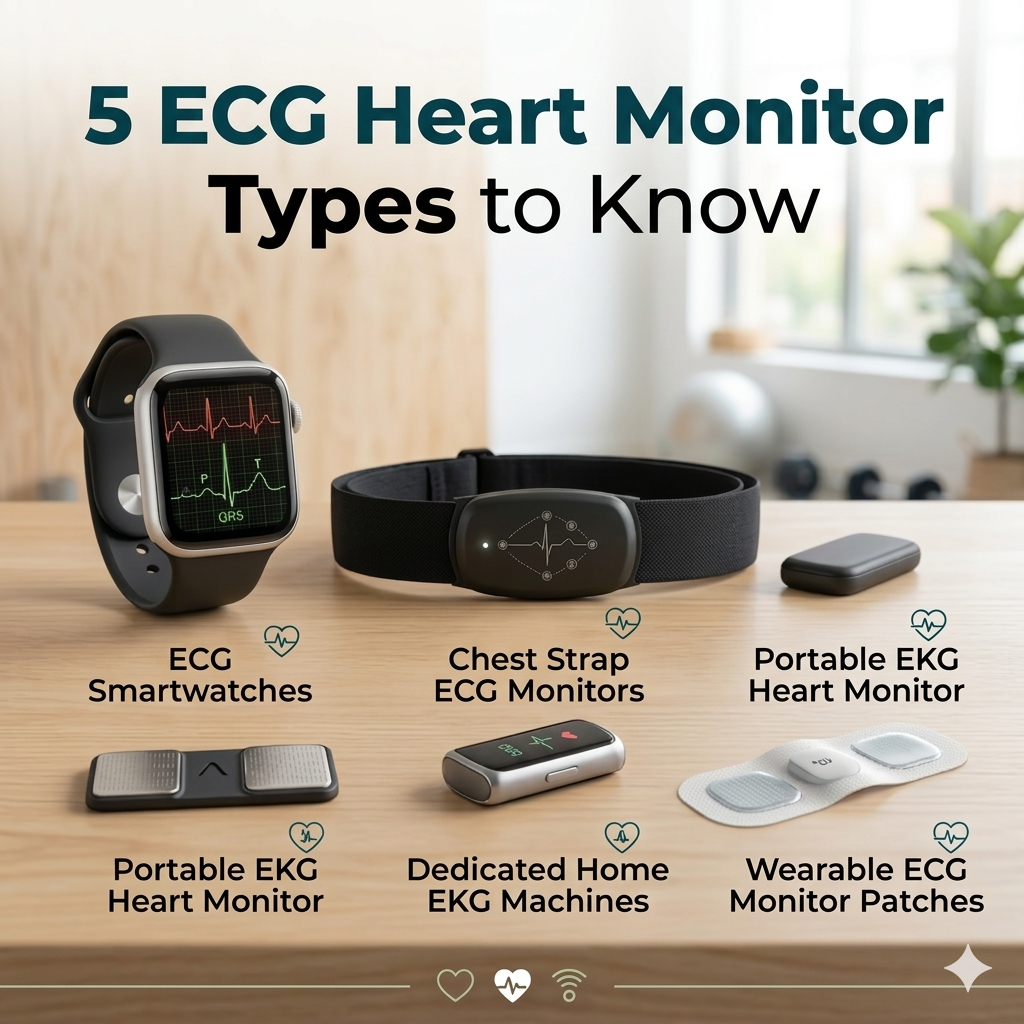
1. ECG Smartwatches — The Everyday Heart Rate Monitor with ECG
The ECG-enabled smartwatch is the most widely adopted heart rate monitor with ECG on the market right now. Devices like the Apple Watch Series 10, Samsung Galaxy Watch 7, and Google Pixel Watch 3 all include on-demand ECG functionality alongside continuous background heart rate tracking.
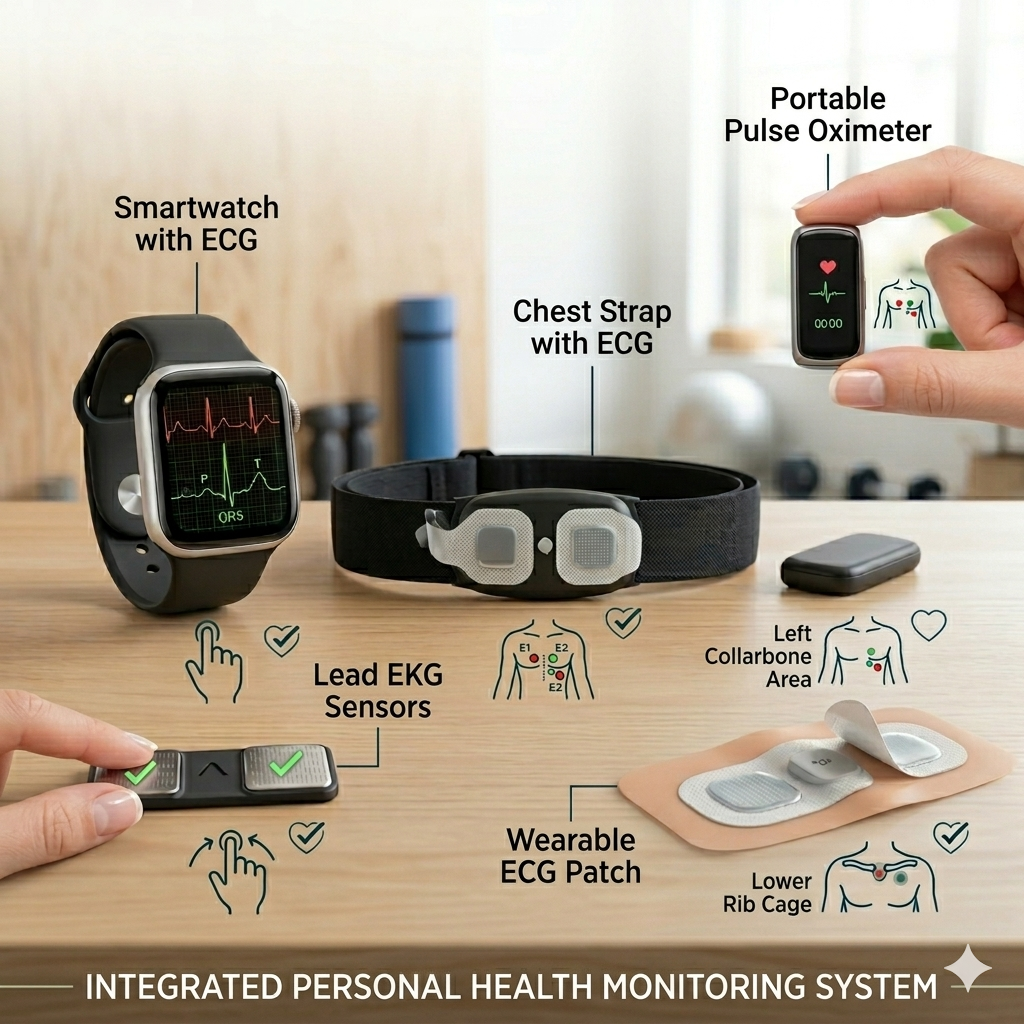
The Apple Watch offers on-demand ECG capabilities that can help detect early signs of atrial fibrillation, alongside continuous heart rate monitoring throughout the day and night. Most of these devices activate their ECG sensor when you hold a finger against the watch’s crown or bezel for about 30 seconds, generating a single-lead rhythm strip interpreted automatically by the companion app.
The strength of an ECG smartwatch as a heart rate monitor with ECG lies in the passive, always-on monitoring it provides between active readings. You’re not just checking your ECG when you feel something — the watch is quietly watching your heart rate all day and alerting you if it detects anything unusual. For the person who wants a heart rate monitor with ECG integrated seamlessly into daily life without any extra device to carry, this category is the obvious starting point.
The limitation: most smartwatches capture a single-lead ECG. It’s good enough for AFib detection, but less comprehensive than multi-lead devices for complex rhythm analysis.
2. Portable EKG Heart Monitor — The On-Demand Specialist
A portable EKG heart rate monitor is a small, dedicated device you use specifically when you want to record your heart rhythm. These aren’t worn continuously — they’re grabbed when you feel something off, or used on a regular schedule your doctor recommends.
The most clinically validated portable EKG heart rate monitors remain a top cardiologist recommendation for at-home use. Entry-level single-lead versions deliver a 30-second rhythm strip straight to your smartphone, while stepping up to a 6-lead device captures a wider range of arrhythmias with significantly better diagnostic detail.
What makes a portable EKG heart rate monitor uniquely valuable is the combination of clinical credibility and low cost. These are FDA-cleared devices with published clinical validation behind them, at a price point well below a smartwatch. If you don’t want to wear a device all day but want a reliable heart rate monitor with ECG available the moment symptoms occur, this is the category to focus on.
3. Wearable ECG Monitor Patches — The Long-Game Solution
A wearable heart rate monitor in patch form is adhesive, worn directly over the chest, and records continuously for days or weeks. This is the format that most closely mirrors the Holter monitors used in clinical cardiology — but designed for real-world wear outside a hospital setting.
The primary use case for a wearable ECG monitor patch is catching arrhythmias that occur infrequently. If you have palpitations once a week, a 30-second reading from a handheld device is statistically unlikely to catch the episode. A patch worn continuously for two weeks has a dramatically higher probability of recording whatever your heart is doing when symptoms hit.
Continuous ECG monitoring devices in patch form are increasingly available through cardiologist prescriptions, though newer consumer-grade options are emerging. If a device repeatedly flags concerns, your cardiologist may recommend further testing — such as a Holter monitor, ECG patch, or echocardiogram — to look more closely at your heart’s electrical activity and structure. For anyone prescribed ambulatory heart rate monitoring, this is the device category involved.
4. Dedicated Home EKG Machines — Multi-Lead Depth Without the Clinic
EKG/ECG machines designed for home use sit somewhere between a clinical device and a consumer gadget. Several reputable manufacturers now produce ECG monitors for at-home use that capture multiple leads and generate detailed rhythm strips comparable to what you’d see in a clinical setting — without requiring a hospital visit or medical training to operate.
A handheld ECG heart monitor in this category typically requires you to hold electrodes in both hands and sometimes place additional sensors on your chest or ankles to capture multiple leads. The resulting ECG is more comprehensive than a single-lead smartwatch reading — which is why these devices are favored by people with established diagnoses who need detailed, regular data to share with their care team.
5. Chest Strap ECG Monitors — The Athlete’s Heart Rate Monitor with ECG
For athletes, the chest strap remains the gold standard heart rate monitor with ECG during exercise. The Polar H10 chest strap remains the gold standard in heart rate monitoring for athletes and clinicians alike, consistently delivering highly accurate data that closely matches clinical ECG readings.
In independent testing against reference ECG equipment, the Polar H10 consistently matched readings within 1–2 BPM across every workout type — including intervals, steady-state cardio, weight training, and cold conditions. For any athlete who needs a heart rate monitor with ECG that performs accurately during intense effort rather than just at rest, a chest strap delivers what wrist-based optical sensors cannot.
What to Look for When Buying a Heart Rate Monitor with ECG
With dozens of products calling themselves a heart rate monitor with ECG, the buying decision can feel overwhelming. Here’s what actually separates good devices from bad ones:
FDA Clearance. A heart rate monitor with ECG used for health monitoring should be FDA-cleared or FDA-approved. This means the device has been tested for safety and accuracy by a regulatory body. This is non-negotiable — don’t make cardiac decisions based on data from uncleared devices.
Number of Leads. Single-lead is sufficient for AFib and basic rhythm detection. Six-lead provides meaningfully more diagnostic information. Twelve-lead is clinical-grade. The right number depends on what you’re monitoring for and what your doctor recommends.
AI-Powered Interpretation. The best heart rate monitor with ECG doesn’t just collect data — it tells you what the data means. Modern devices use AI trained on millions of cardiac recordings to flag abnormalities automatically. ECG sensors can tell you the pattern of beats — detecting irregularities like atrial fibrillation, a condition that causes up to 35% of strokes and often goes undetected until it’s too late. A heart rate monitor with ECG that provides automated, AI-assisted interpretation turns raw waveforms into actionable information.
App Quality and Data Sharing. The companion app is where your heart rate monitor with ECG data becomes useful beyond the moment of recording. Look for apps that store readings over time, generate shareable PDF reports, and offer clear trend visualization. The ability to send recordings directly to your cardiologist is one of the most practically valuable features any portable heart monitors with ECG can offer.
How to Use Your Heart Rate Monitor with ECG the Right Way
Buying a heart rate monitor with ECG is only step one. Getting meaningful value from it requires using it thoughtfully.
Record at consistent times. Taking readings at the same time each day — morning, before meals, or after rest — builds a baseline that makes abnormalities easier to spot. A ECG heart rate monitor used sporadically gives you fragmented data; used consistently, it gives you a picture.
Capture readings during symptoms. The whole point of having a portable heart rate monitor with ECG is to use it when something feels off. Don’t wait until you’re back to normal — take the reading while you’re experiencing the sensation.
Build a record to share. A single reading from a heart rate monitor with ECG tells your doctor one data point. A month of readings tells a story. Export your data, organize it chronologically, and bring it to appointments. Cardiologists consistently report that patient-generated ECG data from home monitors changes and improves the clinical picture they work from.
Know when the device isn’t enough. A heart rate monitor with ECG is a monitoring tool — not an emergency response. If you experience chest pain, sudden severe shortness of breath, arm or jaw pain, or signs of a stroke, call 911. No heart monitor with EKG reading is worth taking in the middle of a potential cardiac emergency.
Why 2026 Is the Best Year Yet to Start Monitoring Your Heart
The convergence of three things — hardware quality, AI interpretation, and insurance support — makes 2026 a genuinely strong moment to invest in a heart rate monitor with ECG.
Hardware has reached a level of miniaturization and accuracy that would have been considered clinical-grade only a few years ago. AI interpretation models have been trained on tens of millions of real cardiac recordings and now flag conditions like AFib with accuracy that cardiologists find clinically useful. And insurance reimbursement for prescribed remote cardiac monitoring has expanded significantly, meaning prescribed monitoring solutions may be partially covered depending on your plan.
Resources like HealthTechInfo publish regularly updated, expert-reviewed comparisons across the full range of ECG-capable devices — which is worth bookmarking if you’re in the process of evaluating options across different form factors and price points.
The bottom line is straightforward. An ECG monitor puts information in your hands that used to require a cardiology appointment to obtain. Used consistently and shared with your healthcare provider, a heart rate monitor with ECG doesn’t replace professional cardiac care — it makes it dramatically more informed, more responsive, and more personal.
FAQ Section
Q: What is the difference between a heart rate monitor and a heart rate monitor with ECG?
A standard heart rate monitor counts your beats per minute using light sensors. A heart rate monitor with ECG captures the actual electrical waveform of your heart rhythm, detecting arrhythmias, AFib, and irregularities that a basic beat count would completely miss.
Q: Is a wearable ECG monitor accurate enough for real medical use?
Yes. FDA-cleared wearable ECG monitors have demonstrated clinical accuracy for detecting AFib and common arrhythmias. They aren’t equivalent to a 12-lead hospital ECG, but they’re reliable enough for meaningful at-home monitoring and cardiologist review.
Q: Can I use an EKG monitor at home without any medical training?
Absolutely. Modern EKG monitors for at-home use require nothing more than placing fingers on sensors or wearing the device. The companion apps provide automated interpretations, so no medical knowledge is needed.
Q: How is a portable EKG heart monitor different from a smartwatch with ECG?
A portable EKG heart monitor is a dedicated, on-demand device with stronger clinical validation. A smartwatch with ECG offers all-day passive monitoring but typically with fewer leads and less diagnostic depth.
Q: What is a heart monitor patch and how long do you wear it?
A heart monitor patch is an adhesive ECG sensor worn directly on the chest for continuous recording — typically anywhere from a few days to several weeks — used to catch infrequent arrhythmias that a short office ECG would miss.
Q: Can these devices detect AFib?
Yes, and it’s one of their strongest use cases. Multiple FDA-cleared heart rate monitors with ECG have demonstrated solid accuracy for AFib detection. Any positive result should always be confirmed by a cardiologist before treatment decisions are made.
Q: Do I need a prescription to buy a portable ECG device for home use?
Most consumer heart rate monitors with ECG — smartwatches, handheld monitors, and basic home ECG machines — are available over the counter. Some advanced patches used for clinical ambulatory heart rate monitoring may require a physician’s order, so always check before purchasing.
Q: What should I do if my home ECG device shows an abnormal reading?
Stay calm, save the reading, note when it happened and what you were doing, and follow up with your doctor. If you’re also experiencing chest pain, severe shortness of breath, or stroke symptoms, call 911 immediately.
Q: How does a handheld ECG heart monitor compare to a hospital ECG?
A hospital ECG uses 12 leads for a comprehensive cardiac view, while a handheld ECG heart monitor typically captures 1 to 6 leads. For detecting common arrhythmias, that difference is manageable — for complex diagnoses, a full clinical test remains the standard.
Q: Are AI-powered ECG interpretations reliable?
They’ve improved significantly. Modern AI platforms flag AFib and several other conditions with accuracy cardiologists find useful as a screening tool. Results still warrant human medical review, but it’s far better than interpreting a waveform with no guidance at all.